That Thick, Sticky Mucus You Can't Clear Is Probably Not Allergies.
The silent-reflux pattern most allergy meds never touch. And the chewable designed to support the tissue behind the constant throat-clearing.
Ever since I told my own story on this site, the emails I get most start with the same six words: "I don't have heartburn, but..." Here is the pattern I finally learned to spot, and the 30-second kitchen-table test that sorts real allergies from the other thing.

Dear friend,
If you found your way here, I have a guess about how your morning started.
Not with an alarm. With that feeling. Something thick at the back of your throat, there before you even opened your eyes. You swallowed. Still there. You cleared it. Five minutes later, back again.
Maybe you were at the bathroom sink for a while this morning. Maybe you keep lozenges in every coat pocket, run a humidifier, take the little allergy pill every day the way some people take vitamins. And maybe, like a reader I'm going to tell you about, you've done all of that for years and the throat-clearing never actually stopped.
I'm not going to sell you anything for the next few minutes. I want to tell you about an email I almost answered wrong, because the mistake I nearly made is the exact mistake that may be running your life right now.
The Email I Almost Answered Wrong


Some of you know my story. I spent six years on a daily acid pill before I understood what was actually wrong with me, and when I finally fixed it, I built Belly Beans and wrote the whole thing up on this site. I expected to hear from heartburn people. I did.
But the emails that stopped me cold were the other ones.
A reader I'll call Marie wrote me last winter. She's 54, a teacher, and she'd been "an allergy person" for eight years. Her words: "I clear my throat so often my students imitate it. I've taken every allergy pill on the shelf. I've used the nasal spray, the rinses, the humidifier. I've seen two ear-nose-throat specialists. One put a camera down my throat and told me everything looks fine. Sarah, everything is not fine. I sound like a smoker and I've never smoked. But I don't have heartburn, so I know my problem isn't your problem. I guess I'm just writing to say your story made me feel less crazy."
I almost wrote back something kind and useless. I'm sorry, I don't think my story applies to you.
Then I got to the line where she described the mucus itself. Thick. Sticky. The kind you almost have to force up. Worst first thing in the morning, before she'd eaten a bite. No sneezing. No itchy eyes. Antihistamines barely made a dent.
And the hair on my arms stood up. Because by then I'd spent two years deep in this world, reading the research, talking to people who study the upper digestive tract. And I knew something Marie didn't.
That is not what allergy mucus looks like.
The 30-Second Test That Sorts "Allergies" From The Other Thing
Specialists who see both allergy patients and reflux patients will tell you the two problems leave different fingerprints, and the fingerprint is the mucus itself. You can run this check at your own kitchen table.
If it's really allergies, the pattern tends to look like this:
- Thin, watery, nearly clear
- Comes with sneezing, itchy eyes, a runny nose
- Flares with pollen, pets, dust, the change of seasons
- Gets noticeably better within days on an antihistamine
If it's the other thing, the pattern tends to look like this:
- Thick, sticky, ropy. The kind you work to bring up
- Worst in the morning and after meals
- No sneezing. No itchy eyes. No runny nose
- Barely responds to allergy pills or nasal sprays
- Flares after coffee, wine, tomato sauce, spice, or eating late
- Often travels with a raspy voice, a lump-in-the-throat feeling, or a dry cough
Read Marie's email against those two lists and it isn't close. And if you've read this far, I suspect your own answer isn't close either.
So what is "the other thing"?
The Part Nobody Had Ever Explained To Her
It's called silent reflux. The medical name is a mouthful, laryngopharyngeal reflux, and doctors who study it have been saying for years that it is one of the most common causes of chronic throat clearing, stubborn throat mucus, and unexplained hoarseness. It gets missed constantly, and it gets missed for one simple reason.
Most people who have it never feel heartburn. Not once.
Published estimates suggest only about one in three people with this pattern ever feel the classic burn in the chest. So nobody, not the sufferer, and too often not the doctor, ever thinks "stomach." They think allergies. Sinuses. Stress. The camera goes down, the throat looks more or less fine, and everyone shrugs.
Here's what's actually happening, and if you read my original story, this is going to sound very familiar.
Remember my raincoat? Your stomach is supposed to be acidic. That was never the problem. The stomach handles its own acid because it wears a raincoat, a natural layer of protective mucus between the acid and the tender tissue underneath.


Now here's the part that applies to Marie, and maybe to you. The tissue at the back of your throat never got a raincoat. It was never supposed to need one. It sits one floor above the storm.
But when the seal at the top of the stomach gets tired and lets stomach contents drift upward, tiny amounts, quietly, no burn, that unprotected throat tissue gets rained on. And it does the only thing it knows how to do to protect itself.
It improvises a raincoat. Out of mucus.
That thick blanket at the back of your throat isn't a malfunction. It's your body trying to shield tissue that's being irritated from below. And it gets worse: pepsin, a digestive enzyme that travels up with reflux, physically changes that mucus, making it thicker, stickier, and harder to clear. Researchers mapped one of the pathways behind this as recently as 2024. The "I can never fully clear it" feeling isn't in your head. The mucus is literally different.

So the cycle runs like this. The tissue gets irritated. The glands lay down a protective blanket. Pepsin thickens it. You clear it. The irritation is still there, so the glands make more. You clear it again. Forty times a day. For eight years.
You haven't been fighting mucus. You've been fighting your own body's defense system, while the thing it's defending against goes completely unaddressed.
Skip ahead: what I told Marie →Why The Allergy Aisle Never Stood A Chance

I want to be fair here, the way I try to always be. Nothing you bought was stupid, and nobody conned you. Every product in that drawer is genuinely good at its actual job.
Antihistamines calm a histamine reaction. If your problem were pollen, they'd be working. Nasal sprays quiet swollen sinus passages, one floor above where your problem lives. The rinses wash out the sinuses, same floor, same miss. And the throat drops and coating syrups? They feel lovely for about ten minutes, because they soothe the place where the irritation lands. Then you swallow, and they're gone, and nothing has changed about where it starts.
Follow the money for one honest second, like I did with my pill. An allergy customer who never gets better is a beautiful business. You don't buy an antihistamine once. You buy it every month, forever, and each spring the shelf gets a new box with a new word on it, and nobody anywhere in that aisle makes a dollar by sitting you down and asking the one question that would end the whole subscription:
"Is your mucus thick or thin?"
Eight years, Marie ran that carousel. Two thousand dollars, give or take, she told me later. All of it aimed one floor above the problem.
So I Told Her What I'd Made
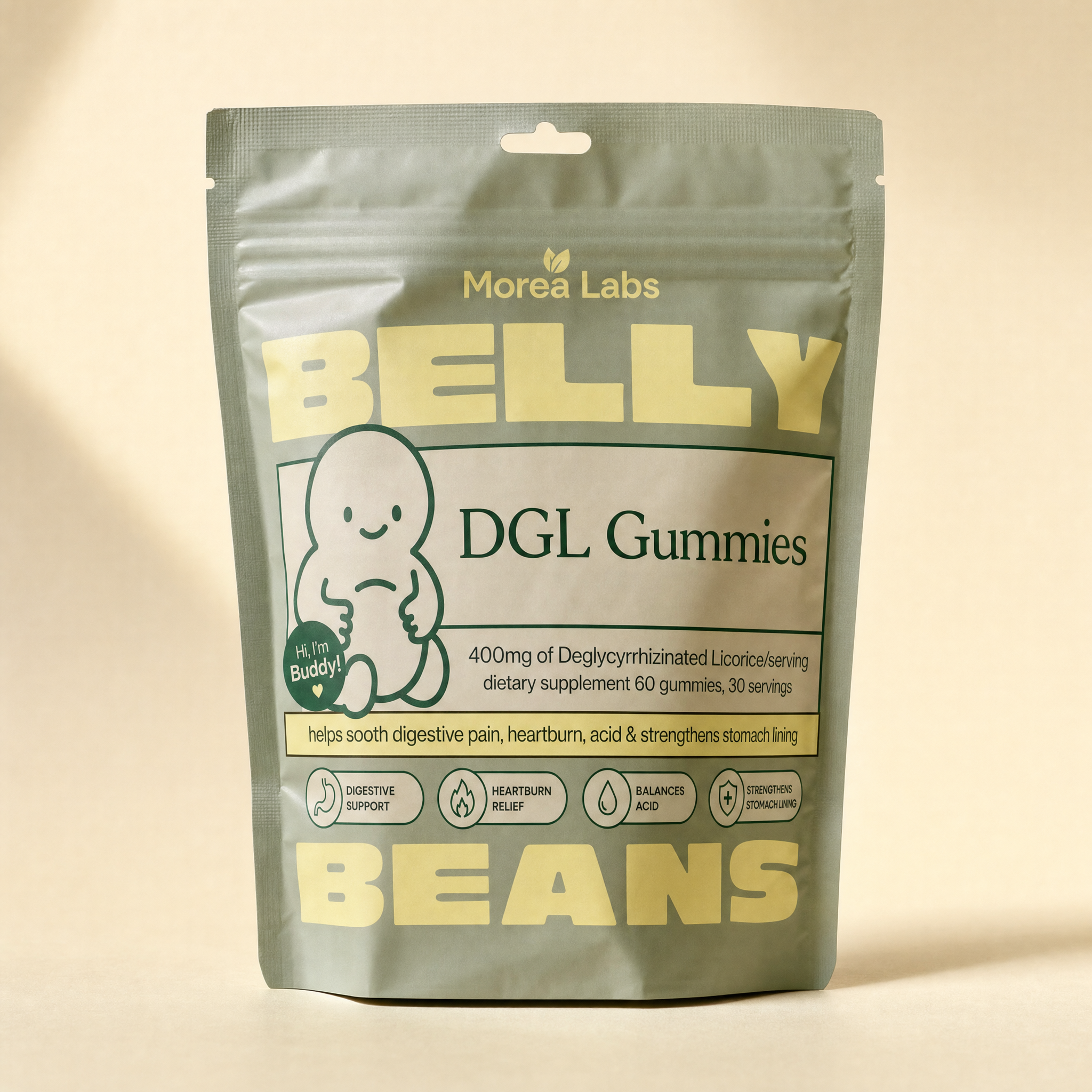
I wrote Marie back a long email. The short version of it is this page. And the last part of it was about Belly Beans, because the thing I'd built for my own worn raincoat turned out to matter even more for people like her.
Belly Beans is DGL, deglycyrrhizinated licorice. Licorice root has been reached for to settle stomachs for centuries, and the "deglycyrrhizinated" mouthful just means the compound tied to blood-pressure concerns has been removed. What's left is the part traditionally used to support the stomach's own natural defenses. The protective mucus layer. The raincoat.
It doesn't go to war with your acid. You need your acid. It works on the other side of the equation, the protection side, which is the side nobody in the allergy aisle was ever going to look at.
And for the throat version of this story, the form turned out to be everything. DGL was always meant to be chewed. That's not a gummy company talking, that's how the ingredient has been used for decades. Here's the whole thing:
- You chew two before your first meal. Chewing gets your saliva moving, and every swallow travels the exact path the trouble travels, top to bottom. A tablet you gulp with water skips all of it.
- 400mg of DGL per serving, the deglycyrrhizinated kind with the blood-pressure compound removed.
- It supports your body's own protective layer down where the story starts, instead of drying up the defense your throat is putting up.
- It tastes like a berry candy, not a chalky tablet. Which means, unlike the drawer full of things you abandoned, you'll actually still be taking it in week six.
That last line matters more than it looks. The honest secret of this whole category is that the thing that helps is the thing you keep doing. Marie didn't abandon eight years of allergy products because she's flaky. She abandoned them because they were chores that didn't work. This is neither.
Show me the starter pouch →What The First Couple Of Weeks Tend To Look Like

I'll set honest expectations, because if you're anything like Marie, broken hope is half of why you're skeptical, and you've earned it.
This is not a fire extinguisher. A throat that has spent years putting up a protective blanket does not take it down in an afternoon. What readers describe, and what I tell everyone to actually watch for, is the mornings. Somewhere in the first couple of weeks, the wake-up mucus starts feeling thinner. Easier. The sink ritual gets shorter. Then one dinner you realize you got through the whole meal without that little ahem between sentences, and your spouse noticed before you did.
Marie's version, about five weeks in: "I still reach for the throat spray out of habit and then realize I haven't needed it. My students have stopped imitating me. I didn't cry about my throat for eight years and I cried about that."
Two honest cautions, because I'd rather lose a sale than your trust. First, persistent throat symptoms, mucus, hoarseness, a cough that won't quit, can have many causes, and some of them need a doctor's eyes. If your voice has been hoarse for more than a few weeks, get it looked at, full stop. Ask your doctor whether silent reflux could explain what you're feeling; it's a very useful question. Second, if you're on a prescription acid medication, do not stop it on your own or cold turkey. Talk to your doctor first. Belly Beans is something you bring into that conversation, not a stunt you pull alone.
You Do Not Have To Take My Word For It
I'm the founder, so of course I'm going to tell you it helps. Here are people with no reason to say so.
"Twenty minutes at the sink every morning, for years. I was sure it was sinus drainage. Allergy pills did nothing because, it turns out, I didn't have allergies. Six weeks of chewing two before dinner and my mornings are just... mornings. I keep waiting for the ritual and it isn't there."
Individual experiences. Results may vary and are not typical.
"I was the guy who cleared his throat before every sentence in every meeting. Two specialists told me my throat looked fine. The thick-versus-thin mucus thing was the first explanation that actually matched what I had. A month in, a coworker asked me what changed. I hadn't even noticed it had stopped."
Individual experiences. Results may vary and are not typical.
"I teach, so my voice is my paycheck, and it had been raspy for three years. Everyone said allergies. Reading about the raincoat, I finally understood why nothing from the pharmacy ever helped. Two months in, my morning voice is my actual voice. I didn't realize how much of myself I'd written off as gone."
Individual experiences. Results may vary and are not typical.
I'll Let You Go In A Moment
That's really the whole story. The mucus was never the enemy. It was your body improvising a raincoat for tissue that was being quietly rained on from below, and every product in the allergy aisle was aimed one floor too high.
If you take nothing else from this page, take the sentence I wish someone had sent Marie eight years ago: thick, sticky mucus with no sneezing is not an allergy pattern. Say it to your doctor. Ask about silent reflux by name. That question is free, and it's the truest thing on this page.
So that's it. Thank you for reading this far. Go ask the question.
...Although. If you asked me, "Okay Sarah, but what do I actually do while I'm waiting for that appointment," I'd feel cruel sending you off without answering. So before you go, sit with one number the way I made Marie sit with it.
Add Up What "It's Just Allergies" Actually Costs
Not the money first. The other bill.
How many conversations have you interrupted with that little sound? How many mornings started at the sink? How many dinners spent timing your swallows, how many phone calls where you heard your own voice and winced? Marie counted eight years. Eight years of being the throat-clearing person, at work, at the table, in her own classroom.
Now the money, since we're here.
| What "managing your allergies" has cost | The honest tally |
|---|---|
| A daily antihistamine, years running | A monthly charge for the wrong problem |
| Nasal sprays, rinses, drops, humidifiers | The carousel that never quite works |
| Specialist visits and the camera down the throat | Hundreds of dollars to hear "looks fine" |
| Lozenges in every coat pocket | Small money, constant reminder |
| Your voice, your dinners, your patience | Paid in joy, not dollars |
| One pouch of Belly Beans | $23.67. One time. Against all of that. |
Against all of that, here is what I'm actually asking of you today.
Here Is The Honest Deal

I want the first pouch to be an easy yes, because I know exactly how many boxes and bottles have already let you down, and I'm not going to ask you to make a big bet on a stranger's story.
That's it. Two gummies, chewed before your first meal. 400mg of DGL per serving, with the blood-pressure compound removed. A berry flavor you'll actually reach for. The raincoat, working where the story starts.
Send Me My Starter Pouch →My 60-Day Promise

Here's how serious I am.
Try it for a full 60 days. If the mornings still start at the sink, if the little ahem is still running your meetings and your meals, write to me and I'll refund every penny. You don't mail anything back. You don't explain yourself past "it wasn't for me."
I can offer that because of how this tends to go once people actually stick with it, and because after watching Marie spend two thousand dollars on the wrong aisle, "just tell me and keep the pouch" is the only kind of promise I'd have believed either.
The risk here is entirely mine. All you're risking is one more morning that sounds exactly like all the others.
Try It Risk-Free For 60 Days →One Honest Heads-Up Before You Decide
I won't put a fake countdown clock on this page. You've seen a hundred of those, and frankly they insult the kind of careful, burned-too-many-times reader who makes it this far down.
But I do owe you one true thing. A good berry gummy that's actually 400mg of DGL per serving is genuinely hard to make. We make it in real batches, and when a batch of starter pouches runs out, it runs out. It has happened before, and the people who'd been "thinking about it" wrote in asking when it was coming back.
So I'll just say: if the thick-versus-thin test hit home, don't be the person waiting on the next batch with a lozenge in your cheek.
Grab My Starter Pouch While It's In Stock →The Two Roads From Here


You'll close this page in a minute either way, so let me lay it out plainly.
One road is tomorrow morning sounding exactly like this morning. The sink. The lozenges. The pill for the allergies you might not even have. The little sound before every sentence, so constant that people who love you have learned to talk over it. That road costs nothing today. It costs you a little bit of your voice every day, forever.
The other road starts with one small pouch, one question for your doctor, and the chance, just the chance, that in a few weeks you get through an entire dinner, an entire meeting, an entire phone call, and nobody hears the throat-clear. Including you.
Marie took the second road because someone finally explained the first one to her. Consider this me, explaining it to you.
Yes, Send Me My Starter Pouch →Exactly What To Do Next
- Tap the button above and claim your first-time-reader starter pouch for $23.67 with free shipping.
- Chew two gummies before your first meal of the day. Chewing is the point. That's the entire ritual.
- Watch the mornings. This is a raincoat, not a fire extinguisher. The change shows up in the rearview mirror, usually starting with the wake-up mucus.
- Ask your doctor about silent reflux by name, especially if your voice has been hoarse for more than a few weeks. And never stop a prescription on your own.
- If it's not for you, tell me inside 60 days and I'll refund you. Keep the pouch.
A Few Honest Questions People Ask Me
"I have never had heartburn in my life. How can this possibly be reflux?"
That's the defining feature of silent reflux, not an exception to it. Published estimates suggest most people with the throat version never feel chest burning at all. The trouble drifts up quietly, and the throat, not the chest, raises the alarm. No heartburn doesn't mean no reflux. It usually just means the alarm is going off one floor higher than you were told to listen.
"I really do have allergies. Tested and everything."
Then you might have both, and plenty of people do: a real allergy layer, plus a reflux layer underneath keeping the mucus thick. The two don't compete. Belly Beans doesn't touch your allergy routine; it works on the protection side of a completely different problem. The tell is the leftover: if the antihistamine handles the sneezing but the thick morning mucus never leaves, the second layer is worth addressing.
"Isn't licorice bad for blood pressure?"
That's the most reasonable worry on this list, and it's the whole reason we use DGL. Deglycyrrhizinated means the compound in licorice tied to blood-pressure concerns has been removed. What's left is the part that supports your lining's natural defenses.
"I'm already on an acid-reducing pill. Can I take both?"
Many readers do. The pill lowers how much acid your stomach makes. Belly Beans works on the other side, supporting the natural protective layer along the path. Different jobs. Check with your doctor before adding anything to a medication routine, and never stop a prescription on your own.
"Why wouldn't I just use a throat-coating syrup? At least it touches my throat."
Because it soothes where the irritation lands, then it's swallowed and gone. Ten nice minutes, nothing changed underneath. The throat mucus is being produced in response to something starting one floor down. Support the protection down there, where DGL does its traditional work, and you're finally aimed at the right end of the problem.
"What if it doesn't work for me?"
Then you're out nothing. Tell me within 60 days, keep the pouch, and I'll refund every penny.
First-time-reader pricing while this batch lasts.
Send Me My Starter Pouch →Reader-Only Offer
Best available price + free shipping
With you in this,
Sarah
Founder, Belly Beans
P.S. If you skimmed to the bottom, here's the sentence that changed everything for Marie, free whether you ever order or not: thick, sticky mucus with no sneezing is not an allergy pattern. Allergy mucus runs thin and travels with sneezes and itchy eyes. The thick morning kind that laughs at antihistamines usually starts one floor down. Ask your doctor about silent reflux by name and watch their eyebrows move.
P.P.S. About the worry still sitting in the back of your mind: yes, this is licorice, and yes, regular licorice can nudge blood pressure in some people. That's precisely why it's DGL. The compound tied to those concerns is removed. 400mg per serving, two gummies chewed before your first meal. Old remedy, modernized, with the worrying part taken out.
P.P.P.S. And the honest, un-fun part: a real berry DGL gummy is hard to make, we batch it, and the starter pouch has sold the page out before. No fake clock. Just the true thing: "I'll think about it" has cost people the batch before. If the thick-versus-thin test finally explained your mornings, take the starter while it's in front of you.
Send Me My Starter Pouch →